Hardening
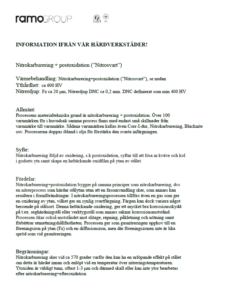
Corr-i-dur or Nitrocarburizing (see more information in the PDF).
Over 100 different trademarks exist for the same processes.
Read more about how our heat treatment workshops describe them.
In everyday terms, it is most simply described as nitrocarburizing + post-oxidation (“Nitro black”).
Do you only need a higher surface hardness? Nitriding, nitrocarburizing, or post-oxidation are heat treatment methods that provide components with improved wear resistance and greater strength.
If the product requires enhanced corrosion protection, post-oxidation is chosen, which is performed in conjunction with nitrocarburizing.
What all these heat treatment methods have in common is that they are low-temperature processes, resulting in no or negligible dimensional distortion of the treated components.
The surface hardness is determined by the material selected and the method of hardening.
The material is cleaned and batch-loaded into a furnace, and the processes are carried out with a closed chamber. Nitrogen gas, nitrous oxide, ammonia, and carbon dioxide are used depending on the method.
All process data is recorded in a data logger for full traceability, ensuring quality assurance of the heat treatment process.
On drawings, the compound layer thickness and case depth should always be specified. Measurement of the treated material can be performed after processing using, for example, the MicroVickers method.
*Click on image to see document